How you can protect Posidonia meadows from your Superyacht.
The Posidonia Oceanica is a marine plant that forms extensive meadows between the surface and 40 metres deep around the Balearic Islands. These underwater forests can host a great diversity of species and are of vital importance for the ecosystem.
Posidonia meadows, also known as seagrass, are a refuge for many species and produce oxygen daily in addition to trapping carbon dioxide from the atmosphere thus creating tons of biomass per year. In the same way, they come to form structures known as barrier reefs, which today are scarce in the Mediterranean, but have great importance and longevity.
The Posidonia protects and defends the beaches. In winter, the accumulation of its leaves on the shore helps to stabilize the bottom and decrease the effect of the surf on the coast and maintains the quality of the sand. In addition to that, the shells of the epiphytic calcareous organisms of the leaves of this plant are integrated into the accumulated substrate generating beaches of whiter sands.
The fact that Posidonia is intolerant of changes makes it an excellent indicator of water quality. If the Posidonia meadows are healthy, means that the quality of the water is very good.
Although it’s protected by different regulations and since 1992 has been considered an area of priority interest for the EU, it is unfortunately also under threat. The increase in activities in the Balearic waters endangers the conservation status of the Posidonia through direct impacts such as anchors, uncontrolled anchoring of boats, pollution of water from outflows and discharges and mass fishing.
The Posidonia meadows are the lungs of the sea as they absorb enormous amounts of CO2; indeed, about half of the oxygen we breathe is produced underwater. These meadows are responsible for the transparency of the Mediterranean waters and the beauty and biodiversity of their landscapes. For the last 5 decades, data indicates that between 13% and 40% of seagrasses have been lost. This is an alarming statistic as sea grass grows very slowly, at a rate of just 2cm per year.
It's therefore essential for us all to take urgent action to take care of Posidonia and its marine ecosystem and spread awareness among our yachting community in Mediterranean waters.
This concerns us all – if there is not enough green, we cannot enjoy the blue!
So, here you have some tips to help us protect the Posidonia:
- Know the regulation regarding ecological mooring buoys, assistance services and anchorage surveillance such as those existing in the natural marine parks around the Balearic Islands.
- Sail with navigation charts and use the available apps that indicate restrictions in protected areas where yachts cannot moor and release anchor.
- Always use ecological products onboard, both personal items such as soap, shampoo and sunscreen, and eco-friendly cleaning products for the yacht.
- Discharge sewage carefully in designated locations.
- If you are going to fish, use methods that respect the seabed.
- Spread the word and share this post!
![sri-lanka-wildlife-udara-karunarathna-ppgm2zpcrzc-unsplash[1].jpg](https://www.anthroworldforum.com/data/attachments/16/16173-aec5cc0c8f3c80398c41145210c26cc0.jpg "sri-lanka-wildlife-udara-karunarathna-ppgm2zpcrzc-unsplash[1].jpg") Posidonia oceanica
Posidonia oceanica, an endemic phanerogam of the Mediterranean Sea , forms extensive meadows around the Balearic Islands, known as submarine forests. These meadows are essential for the ecosystem as they host a diverse range of species and provide crucial benefits.
Mallorca's Guardian of the Neptune Grass(Posidonia)
A total of 19 boats are deployed on the Balearic coast with the task of protecting the Posidonia/Neptune grass.
Play Video
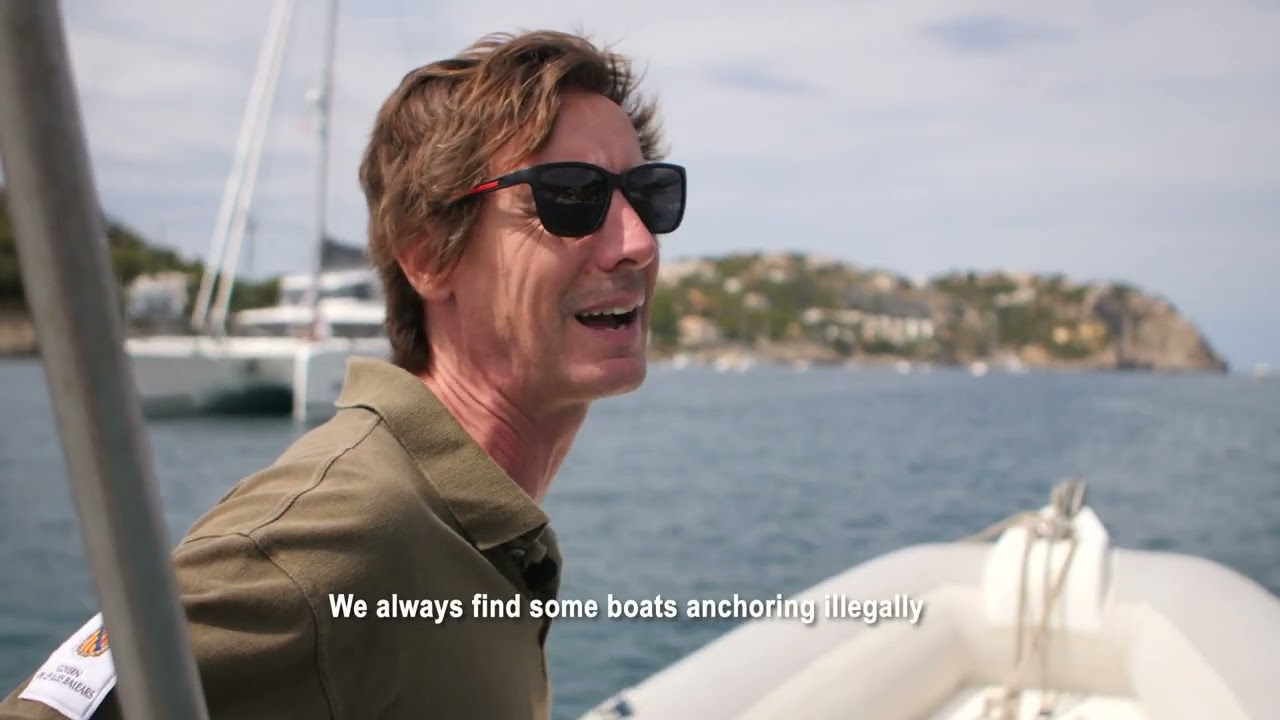
Marcial Bardolet Richter watches over the protection of seagrass beds, which play a particularly important role in the marine ecosystem of the Mediterranean. Presented by TUI Care Foundation
Neptune grass produces oxygen and is considered the “lungs of the Mediterranean”. It is because of it that the
Balearic waters are so crystal clear. It is a typical endemic plant of the Mediterranean. The
seagrass meadows it forms is the basis of important marine ecosystems. “They are not only a habitat for fish and other marine animals but also
play an important role for the climate and the quality of the air we breathe every day as carbon dioxide reservoirs. At the same time, the leaves catch dirt particles and ensure clear water. The plants also protect the beaches from erosion, because the long leaves weaken the waves,” explains Marcial Bardolet Richter.
The Mallorcan with German roots has been committed to
protecting the aquatic plant for many years. Since 2017, he has headed the department for monitoring seagrass meadows at the Balearic Ministry of the Environment. In addition, Bardolet is a member of the “Posidonia Mediterranean Network”, which works closely with the French Biodiversity Office to strengthen nature conservation throughout the Mediterranean.
Marcial Bardolet Richter has been head of the seagrass monitoring department at the Balearic Ministry of the Environment since 2017.
“The Balearic Islands are themselves surrounded by
seagrass carpets of around 650 square kilometres near the coast,” says Bardolet. The plants are also the largest sand producer of all. “Snails and mussels that live in the seagrass and whose shells crumble after they die become the fine, white sand that we value so much,” says Marcial Bardolet.
Up to October, Bardolet’s team sails out into the Mediterranean every day with reconnaissance boats to check whether yachts and pleasure boats are anchoring wrongly. A
total of 19 boats are deployed on the Balearic coast with the task of protecting the Posidonia. Water pollution, shipping and
climate change are the main reasons why the seagrass meadows are suffering.
TV journalist Sibylle Tiessen and cameraman Agustí Torres on assignment at sea.
In 2018, the
Balearic Islands passed a decree that strictly prohibits anchoring on Posidonia. In the meantime, there are several apps that indicate the exact location of seagrass beds with geodata so that anchoring is not allowed there. These include, for example, the seagrass app “Posidonia GOIB”, which was developed by the state government. “The cartographic maps are gladly accepted by boat owners and charter companies,” explains Bardolet. Those who have problems finding the right anchoring spot can also request help via radio channel 68. Incorrect anchoring, on the other hand, faces heavy fines.
But it is not only boat anchors that stress underwater jungles.
Climate change is also causing problems for the aquatic plant. “The Neptune grass likes moderate temperatures between 17 and 20 degrees. Due to ocean warming, however, the water temperature already exceeds this value on most days in midsummer,” explains Marcial Bardolet. At values around 28 degrees, the seagrass beds are acutely and seriously threatened. “If the temperatures continue to rise, the seagrass density will rapidly decrease over the next 30 years,” warns Bardolet. It could take 200 to 300 years for the meadows to grow again.
Neptune grass is considered the miracle plant of the Mediterranean. Here you can see Agusti filming Marcial when he checks the state of the Posidonia.
Wastewater also damages seagrass beds. Turbid water from whatever source reduces the plants’ ability to photosynthesise. Intensive building development and a developed tourism industry that prefers clean, clear beaches for its hotel guests are also “enemies” of the natural balance.
The often praised crystal-clear water of the Balearic Islands only exists because of the Posidonia. The “dirty”, dead seaweed that washes up on Mallorca’s beaches in the eyes of many is also important. It protects the beach from erosion when the autumn and winter storms sweep over it.
Overall, Bardolet rates the cooperation with charter companies and boat owners as positive.
In recent years, illegal anchoring has steadily decreased. In most cases, people are grateful for the educational work and are cooperative, says Bardolet. In addition, the public is now aware of the important role that seagrass beds play for the environment. “Nowhere have I seen more willingness to protect seagrass meadows than in the Balearic Islands,” emphasises Bardolet. This is because everyone agrees on one thing: “Clear water, good air, a healthy environment, satisfied holidaymakers and locals are what everyone strives for. And that is only possible with an intact underwater jungle of neptune grass.”
Cooperation with TUI
Support from the tourism industry: The project is sponsored by Europe’s leading
tourism group Tui and its Tui Care Foundation. The initiative was founded in 2016 with the aim of supporting sustainable projects in destinations. The foundation focuses on the potential of the tourism sector as a driver for social development, education and prosperity. The group promotes sustainable tourism in cooperation with local people.
The oceanic Posidonia is an endemic plant of the Mediterranean(Mallorca). It cannot be found anywhere else.


![1[1].jpg](https://www.anthroworldforum.com/data/attachments/16/16129-61e8fd6ef114d3b65a3e9457091731c7.jpg "1[1].jpg")
![llevant-peninsula-nature-reserve-mallorca-arta-93[1].jpg](https://www.anthroworldforum.com/data/attachments/16/16130-d0360a343439eebe68e521e26d3f8008.jpg "llevant-peninsula-nature-reserve-mallorca-arta-93[1].jpg")
![310149483_original[1].jpg](https://www.anthroworldforum.com/data/attachments/16/16131-4b5a0476f6508f05b8a8dce858324190.jpg "310149483_original[1].jpg")
![120768-baugrundstueck-puigderos-ruhig-kaufen[1].jpg](https://www.anthroworldforum.com/data/attachments/16/16132-f7c8a14a8f409ef55aa2a0dd48628255.jpg "120768-baugrundstueck-puigderos-ruhig-kaufen[1].jpg")
![GVrM5ADWEAAsGb-[1].jpg](https://www.anthroworldforum.com/data/attachments/16/16134-cb3bd9e051d2616e4e18e54d1ee01700.jpg "GVrM5ADWEAAsGb-[1].jpg")
![1000_F_931068881_zsK53lhpSbnHNas2OMKVkhF64RVUK13p[1].jpg](https://www.anthroworldforum.com/data/attachments/16/16135-2e1ba5a090f69e3b1602b48802ec7c3f.jpg "1000_F_931068881_zsK53lhpSbnHNas2OMKVkhF64RVUK13p[1].jpg")
![partnerList-golf-costa-daurada-golfy_6.jpg[1].jpg](https://www.anthroworldforum.com/data/attachments/16/16136-ad755319b595be34c46bd62197cf23c8.jpg "partnerList-golf-costa-daurada-golfy_6.jpg[1].jpg")
![Cala-dor-place-mallorca[1].jpg](https://www.anthroworldforum.com/data/attachments/16/16137-2f8c07aaf1d64b55cb8a430b0f1591ed.jpg "Cala-dor-place-mallorca[1].jpg")
![360_F_516081237_Dp0PoO8eAL2Xk5E7oKcrRCF8Ayl3nhbf[2].jpg](https://www.anthroworldforum.com/data/attachments/16/16145-d5e127043d416a0640a98eb719640b54.jpg "360_F_516081237_Dp0PoO8eAL2Xk5E7oKcrRCF8Ayl3nhbf[2].jpg")
![cala-sa-calobra-escorca-mallorca-yoysoymallorca-1024x383[1].jpg](https://www.anthroworldforum.com/data/attachments/16/16146-154f3ad1cf94266d46f1df15cb0253c9.jpg "cala-sa-calobra-escorca-mallorca-yoysoymallorca-1024x383[1].jpg")
![sa-calobratorrent-de-pareis1[2].jpg](https://www.anthroworldforum.com/data/attachments/16/16147-ffcbd9bec42c8dfcb2995de55f244fdc.jpg "sa-calobratorrent-de-pareis1[2].jpg")
![360_F_639196955_3sk0YRht0agv7w7dCsJ0dHtWUtDhNKWZ[2].jpg](https://www.anthroworldforum.com/data/attachments/16/16148-1359b4ec003af45a899167f6f55524fb.jpg "360_F_639196955_3sk0YRht0agv7w7dCsJ0dHtWUtDhNKWZ[2].jpg")

![The-best-seafront-villa-near-Deia-in-Mallorca22[1].jpeg](https://www.anthroworldforum.com/data/attachments/16/16150-6f680140146118dfb157240633bab041.jpg "The-best-seafront-villa-near-Deia-in-Mallorca22[1].jpeg")
![spain-balearic-islands-mallorca-cala-deia-aerail-view-of-bay-2AAW3JF[1].jpg](/data/attachments/16/16151-16d7de62ececafa092ace5fb7cdc7135.jpg)

![mallorca-2[1].jpg](https://www.anthroworldforum.com/data/attachments/16/16171-3e00bd0267ab78816ab1a49d69d606f3.jpg "mallorca-2[1].jpg")
![puig-galatzo[1].jpg](https://www.anthroworldforum.com/data/attachments/16/16172-86183ed8a52099702b2a9d011f21564e.jpg "puig-galatzo[1].jpg")




![colonia-sant-jordi-mallorca-spain-260nw-1353712298[1].jpg](https://www.anthroworldforum.com/data/attachments/16/16174-3e7f1f090943e8e0271b142bac414f83.jpg "colonia-sant-jordi-mallorca-spain-260nw-1353712298[1].jpg")
![aerial-view-colonia-de-sant-260nw-1628259874[2].jpg](https://www.anthroworldforum.com/data/attachments/16/16175-33ecae76bd2c2b0b9539cab5f733f444.jpg "aerial-view-colonia-de-sant-260nw-1628259874[2].jpg")
![maxresdefault[1].jpg](https://www.anthroworldforum.com/data/attachments/16/16176-d32a149202c5d749ad199c0b4f6ece18.jpg "maxresdefault[1].jpg")
![variant[2].jpg](https://www.anthroworldforum.com/data/attachments/16/16177-e422229bef610b7f52117554e191ede8.jpg "variant[2].jpg")
![destination_15879743541[2].jpg](https://www.anthroworldforum.com/data/attachments/16/16178-d265129e01ea3199643b771fc9ae5db6.jpg "destination_15879743541[2].jpg")
![GWBR6cjX0AAp512[1].jpg](https://www.anthroworldforum.com/data/attachments/16/16179-b1e001a14a88f56b6aa0e76c07e57179.jpg "GWBR6cjX0AAp512[1].jpg")
![27270696[1].jpg](https://www.anthroworldforum.com/data/attachments/16/16180-a898df03e8a1ed683748843435b1219a.jpg "27270696[1].jpg")
![M_185611_l-140934-blau-sant-jordi-1[1].jpg](https://www.anthroworldforum.com/data/attachments/16/16203-2ffa0014c6615d6c80d936c1cb328bc8.jpg "M_185611_l-140934-blau-sant-jordi-1[1].jpg")
![Club-Colonia-Sant-Jordi01[1].jpg](https://www.anthroworldforum.com/data/attachments/16/16202-d0f53cc4be1e291b87adf79081edb0ca.jpg "Club-Colonia-Sant-Jordi01[1].jpg")
![blau-colonia-sant-jordi-aerial[1].jpg](https://www.anthroworldforum.com/data/attachments/16/16204-abe3abfd0e3e09c37a5d204d80f18ee4.jpg "blau-colonia-sant-jordi-aerial[1].jpg")
![aerial-view-beach-area-saura-260nw-2059069457[1].jpg](https://www.anthroworldforum.com/data/attachments/16/16205-53a05fcc7efb3018f29eb38350f19979.jpg "aerial-view-beach-area-saura-260nw-2059069457[1].jpg")


![playa-de-muro-mallorca-yosoymallorca16-pkwhmg41gtjwkqpko6z8y06qo8d9tamxiz2ti9suyg[1].jpg](https://www.anthroworldforum.com/data/attachments/16/16206-c63410132bd0a9deb4e568a81f1efc10.jpg "playa-de-muro-mallorca-yosoymallorca16-pkwhmg41gtjwkqpko6z8y06qo8d9tamxiz2ti9suyg[1].jpg")
![143-portdealcudia2319[1].jpg](https://www.anthroworldforum.com/data/attachments/16/16207-453741718b42faf90da11f61c9d87a84.jpg "143-portdealcudia2319[1].jpg")
![129687[1].jpg](https://www.anthroworldforum.com/data/attachments/16/16208-9e481983578afd60f1348bc235218625.jpg "129687[1].jpg")
![playa-de-muro-majorka-plaza[1].jpg](https://www.anthroworldforum.com/data/attachments/16/16209-4533bf7f343431faaca6caa5ebb958cc.jpg "playa-de-muro-majorka-plaza[1].jpg")
![F-Esp-Playa-Muro-Mallorca-Pabisa-Hotel[1].jpg](https://www.anthroworldforum.com/data/attachments/16/16210-663561fcf87fa4480e8f393558799bc0.jpg "F-Esp-Playa-Muro-Mallorca-Pabisa-Hotel[1].jpg")


![ea6468bd-7567-4658-80c3-62c8a20a488c_16-9-discover-aspect-ratio_default_0[1].jpg](https://www.anthroworldforum.com/data/attachments/16/16211-b34102e0349ce5a72bf0bfe482b90be9.jpg "ea6468bd-7567-4658-80c3-62c8a20a488c_16-9-discover-aspect-ratio_default_0[1].jpg")
![an-aerial-view-of-the-marina-port-de-mallorca-in-palma-balearic-islands-spain-2G9G1HY[1].jpg](https://www.anthroworldforum.com/data/attachments/16/16212-7d85472121695f8a778dd80351133f94.jpg "an-aerial-view-of-the-marina-port-de-mallorca-in-palma-balearic-islands-spain-2G9G1HY[1].jpg")