i doubt it
iran n is "dark" in the sense dark hair and eyes . but modern baloch people are not a good proxy
Didnt say modern day balochs are a good proxy, but this is from people who have done a deeper dna analysis themselves regarding this subject(you can read the comment from Ygor in this quora thread, to get an insight):
Answer (1 of 7): First of all, let me just point out that it is still very controversial to really establish categorical statements about the skin color of ancient people, because most genetic papers on ancient DNA samples only test for 2 or at most 4 derives alleles that code for loss of skin pi...

www.quora.com
The links he posted:
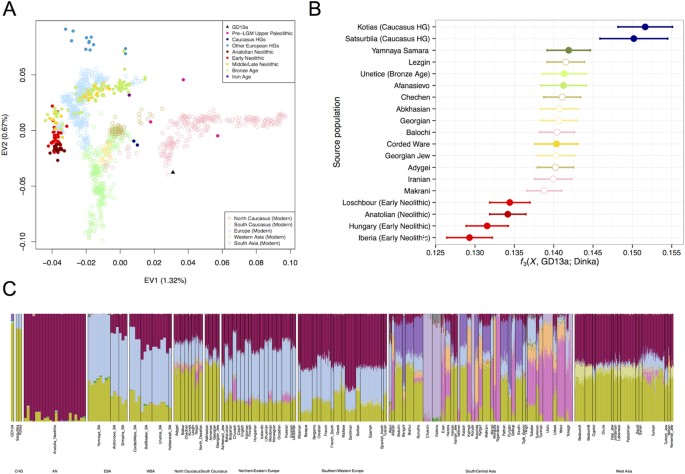
The agricultural transition profoundly changed human societies. We sequenced and analysed the first genome (1.39x) of an early Neolithic woman from Ganj Dareh, in the Zagros Mountains of Iran, a site with early evidence for an economy based on goat herding, ca. 10,000 BP. We show that Western...

www.nature.com
"The phenotypic attributes of GD13a are similar to the neighbouring Anatolian early farmers and Caucasus Hunter-Gatherers. Based on diagnostic SNPs, she had dark, black hair and brown eyes (see
Supplementary). She lacked the derived variant (rs16891982) of the
SLC45A2 gene associated with light skin pigmentation but likely had at least one copy of the derived
SLC24A5 allele (rs1426654) associated with the same trait. The derived
SLC24A5 variant has been found in both Neolithic farmer and Caucasus Hunter-Gatherer groups
5,
15,
24 suggesting that it was already at appreciable frequency before these populations diverged. Finally, she did not have the most common European variant of the
LCT gene (rs4988235) associated with the ability to digest raw milk, consistent with the later emergence of this adaptation
5,
15,
21."
https://genetiker.wordpress.com/2016/07/18/phenotype-snps-from-ancient-iran/ (someone did some analysis of several iranian neolithic samples)
And quotation from a third study, which i cant find now in the quora comment, despite the link being there:
"Consistent with this, outgroup f3 statistics indicate that Iranian Zoroastrians are the most genetically similar to all four Neolithic Iranians, followed by other modern Iranians (Fars), Balochi (SE Iran, Pakistan and Afghanistan), Brahui (Pakistan and Afghanistan), Kalash (Pakistan) and Georgians (figs. S12-S15). Interestingly, WC1 most likely had brown eyes, relatively dark skin, and black hair, although Neolithic Iranians carried reduced pigmentation associated alleles in several genes and derived alleles at 7 of the 12 loci showing the strongest signatures of selection in ancient Eurasians (3) (tables S29-S33)."
As you see, the iranian neolithics were diverse in terms of lightness. Obviously through selection, most west iranians are light as other west asians. But this does sort of explain why you can find darker iranians around Tabriz, Ilam, Kermanshah etc, despite not having any additional south asian or sub saharan heritage, and also being a mix of pre-aryan iranians(basically Iran N with shitton of middleeastern, anatolian farmer influenced admix) and CA aryans(same pigment as iranians around Tehran or Tabriz)