

- Country
-

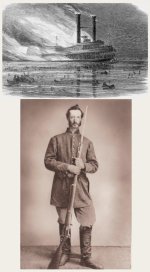
On April 7, 1865, the steamship Sultana exploded on the Mississippi River, killing more than 1,100 passengers, most of whom were Union soldiers returning home from Confederate prison camps at the end of the Civil War.
Among the survivors was Daniel Garber, a private in the 102nd Ohio Volunteer Infantry. He enlisted in 1862, was captured in 1864, and was subsequently sent to the Cahaba prison camp in Alabama. His first-person account of enduring the tragedy can be found in the book Loss of the Sultana and Reminiscences of Survivors, compiled by fellow survivor Chester D. Berry and first published in 1892. An archived audio recording of Garber's account from 1892 is also preserved on the Internet Archive.
Describing the immediate aftermath of the disaster, Garber recalled:
The scene following the explosion was terrible and heart-rending in the extreme. Hundreds of people were blown into the air and descending into the water, some dead, some with broken limbs, some scalded, were borne under by the resistless current of the great river, never to rise again. The survivors represent the screams as agonizing beyond precedent. Some clung to frail pieces of the wreck, as drowning men cling to straws and sustained themselves for a few moments, but finally became exhausted and sunk.
Garber similarly detailed his own harrowing escape in Berry's publication:
By this time, all was confusion and men were jumping off into the river to get away from the flames. I looked around for a clear place to jump, for I knew if I jumped in where men were struggling, they would seize my board and I would be lost, because I could swim, but very little.
On April 25 or 26, Garber was placed on board the ill-fated steamer with approximately 2,100 paroled prisoners. Shortly after midnight on April 27, when the ship was about seven miles above Memphis, Tennessee, its boilers exploded, resulting in the deaths of roughly 1,500 men. Garber was one of only three survivors out of thirteen men from his company who had been on board. He floated eleven miles down the river before being picked up, nearly chilled to death, by the gunboat Pocahontas. On May 21, he was discharged by a special telegram from the War Department.
Despite the immense scale of the loss, the Sultana disaster remains largely absent from mainstream history books and Hollywood films. This oversight is often attributed to poor timing. The explosion occurred just hours after John Wilkes Booth had been captured and killed, while Abraham Lincoln's funeral train was still winding its way cross-country to Springfield, Illinois. In April 1865, following a war in which 620,000 soldiers had already lost their lives, the Sultana tragedy was perhaps overshadowed by a nation in deep collective grief.
Following the war, Garber returned home and worked at his trade for approximately ten years, spending part of that time in Butler, where he built a property later owned by I. C. Ball. He subsequently transitioned to farming, constructing the house and barn on a farm owned by the Hitchman heirs. He spent the final thirteen years of his life living with his son, D. S. Garber, and passed away on April 15, 1906, at the age of 78 years and 12 days.
Efforts to preserve the history of the disaster continue today. The Sultana Disaster Museum is scheduled to hold its grand opening on November 14, 2026, at 10:00 a.m. at its new location: 114 Military Road, Marion, Arkansas, roughly 20 minutes from downtown Memphis, Tennessee. Additionally, the Sultana Historical Preservation Association historically hosts annual descendant gatherings and history conferences around the anniversary of the April 1865 explosion.
This information was compiled with the assistance of Dee Cody, Daniel Garber's great-great-great-granddaughter, who provided resources to help spread awareness of an event often overlooked by traditional historical narratives.
Works Cited
- Berry, Chester D., compiler. Loss of the Sultana and Reminiscences of Survivors. 1892.
- Daniel Garber's First-person Account." Internet Archive, archive.org.
- "Grand Opening." The Sultana Disaster Museum, 2026, www.sultanadisastermuseum.com/groundbreaking. Accessed 24 Sept. 2026.