

- Country
-

Neanderthals:
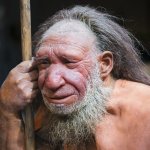
Neanderthals were prehistoric humans who interbred with modern humans before disappearing around 40,000 years ago.
The word “Neanderthal” is a nod to a 17th-century German theologian named Joachim Neander and the secluded valley (Thal) he loved to visit. Nearly 200 years after Neander’s death, peculiar bones were found in the valley — initially believed to belong to a human with bone deformities (it was, in fact, a Neanderthal). It wasn’t until 1886, when two nearly complete Neanderthal skeletons were found in Belgium, that the scientific community recognized the remains for what they were — a unique flavor of human.
Neanderthals were similar to modern humans in many ways, but their skeletal remains reveal a handful of differences, particularly in the face and head. Where modern humans have a relatively flat face and round skull, Neanderthals had a sloping forehead, elongated skull, heavy brow ridge, projecting midface, and almost no chin. Neanderthals also had a more robust body with a “barrel-shaped” chest and thicker bones.
Fun fact: the tallest Neanderthal ever found was around 5’10” — a whopping five inches taller than the average Neanderthal male.
In 1983, a Neanderthal skeleton was found in Israel, and one bone in particular drew the attention of archaeologists and linguists around the world: the delicate, U-shaped hyoid. In humans, the hyoid bone allows for a wide range of sounds required for speech, and the Neanderthal hyoid bone looked human, suggesting Neanderthals were able to talk. Neanderthals also had a nearly-human version of FOXP2, a gene known to be critically important for normal speech and language. The jury’s still out on whether Neanderthals could talk, but the evidence speaks volumes.
While they may have looked a little different, Neanderthals were probably a lot like us. They tended to have slightly larger brains than modern humans, and shared many of our capabilities. They made fire. They used tools and they could probably speak. There’s also evidence that they created jewelry and art. For example, the earliest European art — red-pigment paintings that decorate the walls of caves throughout the continent’s southwest — may have been created by Neanderthals 20,000 years before modern humans arrived in Europe.
European, Asian, and indigenous American populations today have 1–2 percent Neanderthal DNA, but Sub-Saharan African populations have significantly less. While Neanderthal remains have been found close to Africa there is no evidence that Neanderthals ever called the continent home.
Denisovans:
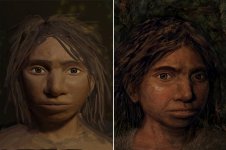
We’ve known about Neanderthals for over a century. But did you know there was at least one other population of archaic humans who interbred with our ancestors? Meet the Denisovans. Bone fragments unearthed in Siberia and Tibet are the only remains ever found belonging to the Denisovans. After their genome was sequenced in 2015, scientists learned that Denisovan ancestry is found in modern humans, reaching 5 percent in some Oceanian populations. However, Denisovan ancestry remains very low in most other groups — typically far less than 0.1 percent. The studies of Denisovan DNA also revealed they were more closely related to Neanderthals than to modern humans.
Neanderthals were prehistoric humans who interbred with modern humans before disappearing around 40,000 years ago.
The word “Neanderthal” is a nod to a 17th-century German theologian named Joachim Neander and the secluded valley (Thal) he loved to visit. Nearly 200 years after Neander’s death, peculiar bones were found in the valley — initially believed to belong to a human with bone deformities (it was, in fact, a Neanderthal). It wasn’t until 1886, when two nearly complete Neanderthal skeletons were found in Belgium, that the scientific community recognized the remains for what they were — a unique flavor of human.
Neanderthals were similar to modern humans in many ways, but their skeletal remains reveal a handful of differences, particularly in the face and head. Where modern humans have a relatively flat face and round skull, Neanderthals had a sloping forehead, elongated skull, heavy brow ridge, projecting midface, and almost no chin. Neanderthals also had a more robust body with a “barrel-shaped” chest and thicker bones.
Fun fact: the tallest Neanderthal ever found was around 5’10” — a whopping five inches taller than the average Neanderthal male.
In 1983, a Neanderthal skeleton was found in Israel, and one bone in particular drew the attention of archaeologists and linguists around the world: the delicate, U-shaped hyoid. In humans, the hyoid bone allows for a wide range of sounds required for speech, and the Neanderthal hyoid bone looked human, suggesting Neanderthals were able to talk. Neanderthals also had a nearly-human version of FOXP2, a gene known to be critically important for normal speech and language. The jury’s still out on whether Neanderthals could talk, but the evidence speaks volumes.
While they may have looked a little different, Neanderthals were probably a lot like us. They tended to have slightly larger brains than modern humans, and shared many of our capabilities. They made fire. They used tools and they could probably speak. There’s also evidence that they created jewelry and art. For example, the earliest European art — red-pigment paintings that decorate the walls of caves throughout the continent’s southwest — may have been created by Neanderthals 20,000 years before modern humans arrived in Europe.
European, Asian, and indigenous American populations today have 1–2 percent Neanderthal DNA, but Sub-Saharan African populations have significantly less. While Neanderthal remains have been found close to Africa there is no evidence that Neanderthals ever called the continent home.
Denisovans:
We’ve known about Neanderthals for over a century. But did you know there was at least one other population of archaic humans who interbred with our ancestors? Meet the Denisovans. Bone fragments unearthed in Siberia and Tibet are the only remains ever found belonging to the Denisovans. After their genome was sequenced in 2015, scientists learned that Denisovan ancestry is found in modern humans, reaching 5 percent in some Oceanian populations. However, Denisovan ancestry remains very low in most other groups — typically far less than 0.1 percent. The studies of Denisovan DNA also revealed they were more closely related to Neanderthals than to modern humans.


