
Anthro World Forum
You are using an out of date browser. It may not display this or other websites correctly.
You should upgrade or use an alternative browser.
You should upgrade or use an alternative browser.
The hidden history of humanity.Impostors/Jews(Rev. 2:9)deceived the world and DNA confirmed it
- Thread starter BarcelonaAtlantis
- Start date

Climbing Mallorca's 1000m Peaks.
There are 54 peaks over 1000 meters high in the Serra de Tramuntana range.
Share
Paul Harrison
3rd October, 2019
Climbers and cyclists flock to Mallorca. But away from the built-up resorts this rugged island also deserves to be better known for hillwalking, says local resident Paul Harrison. Here's his guide to Mallorca's 1000m peaks, a uniquely Mediterranean ticklist.
While the international hiking community has long been aware of the GR221, Mallorca's "Dry Stone Way" which winds for 150km through the mountainous interior, few people even among the island's nearly 1 million residents have heard of the 54 'miles'.
Named for the word mil, Spanish for one thousand, these peaks above 1000m elevation form a logical tick list. A number are a short detour from the GR221 and can be completed in as little as a one hour side trip. Others require long days of hiking in their own right. All offer unique and spectacular days out in the UNESCO World Heritage Site of the Sierra de Tramuntana mountain range.
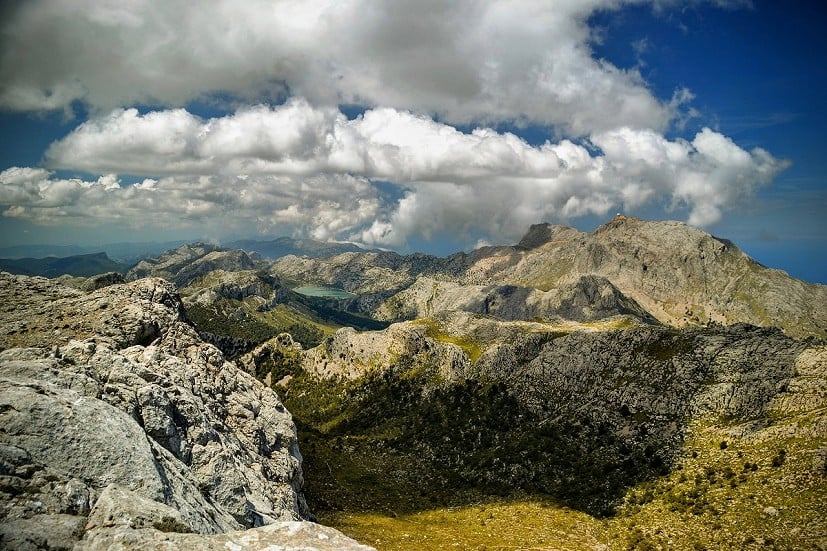 View from the summit of Puig de Massanella - Puig Mayor and Penyal des Migdia clearly outlined to right
© Paul Harrison
I came to the infamous list of 54 'official' 1000m+ peaks entirely by accident a few years ago, whilst using walking as a key part of physical recovery from back surgery. 'Los 54 miles' have since fascinated me. I've scaled 33 of them at the time of writing and have plans to tick off many more through this autumn, winter and spring.The visitor who is prepared to walk can forget everything they've ever heard about Mallorca, and start afresh by making new discoveries every day, around every corner
Paddy Dillon Mountain Walking in Mallorca
For those of us who respect and enjoy the Sierra de Tramuntana, its value and its beauty, scaling those 54 peaks, through fair weather and bad, is a continual pleasure and challenge. The rock, at altitude, is primarily karstic limestone and dolomite. This place is hell on hiking boots. A pair lasts one busy season, two at best with light use. Rubber toe guards are peeled and grazed within hours and knife-edged karst formations slice into soles. Trail runners are becoming a frequent sight on the main paths here but few actually head 'off-piste' as the routes up to peaks are rarely clear paths and cross scree slopes, bare slabs and weathered scrambles which destroy trainers, and hands, of any kind. Equally, the bare rock is gripped best by rubber ferrules on trekking poles and happily destroys one pair per day, often also eating the tungsten-carbide tips beneath.
On the lower slopes Mediterranean pines provide much-needed shade before giving way to forests of Balearic Holm-Oak which characterise the middle slopes. Emerging above the tree line we are treated to displays by ospreys, kites, falcons and the magnificent 'buitre negro' or black vulture (voltor negre in the local language of Mallorquin) which was finally declared as rescued from extinction on the island just last year. Around 1990 there was only one nesting pair on the island, laying eggs only every two years. Due to concerted conservation efforts, there are now over 35 known nesting pairs. On the highest, rockiest slopes sceptical goats watch hikers from afar and munch on wild thyme and juniper berries.
Some of the Sierra de Tramuntana's 54 highest peaks are distinctly alpine in nature. Above the 800m mark there is usually little vegetation, no shade or natural shelter; just the wind and rain shaped limestone teeth and the almost inevitable final scramble to the peak. A couple of key examples, such as Agulla des Frare, require full on rock climbing to complete the final 15 to 20 metres and should absolutely not be attempted without appropriate equipment and experience. On so many of the lesser-known peaks the challenge is navigation, with no path to follow and sporadic, intermittent cairns. GPS is highly recommended unless very familiar with the local terrain and landmarks.
Last edited:
Mallorca's warm, sunny bridge seasons are the perfect time for hiking here, in between the 35ºC of summer afternoons and the mild winter day time temperatures of 10-12ºC. Summer hiking brings hot weather challenges but is balanced by almost guaranteed good weather throughout the season and the temperatures 'up top' can be 10 degrees cooler than on the sweltering beaches at sea level. Winter usually gives us a scattering of snow above 600m and mild temperatures but can be unpredictable; I've experienced first-hand making the final push to the summit when a snow storm appears out of a clear sky and its sideways blizzard leaves visibility at less than 5 metres.
The stunning views from the dramatic peaks are the reward for all that uphill struggle and here the weather is good enough that those views are often accompanied by sunshine and picture-postcard blue skies. Even on cloudy days the altitude means I have had days of sitting on peaks above the cloud layer with clear skies overhead. However, be careful never to underestimate the speed the weather can change at elevation on an island in the middle of the sea, even a sea as benign-looking as the Mediterranean.
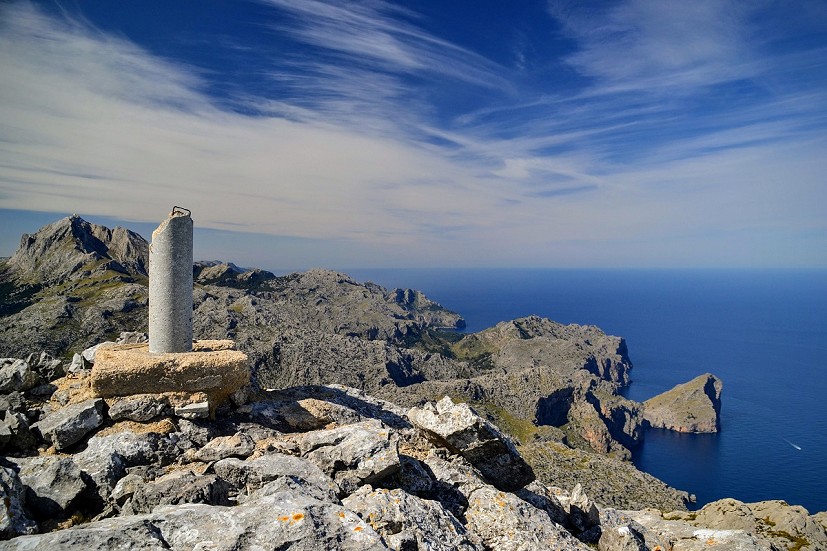 The trig point on top of Puig Roig, where the mountains meet the Mediterranean.
© Paul Harrison
Visible across the island, the dominant peak of Puig Major (1445m) has its own strange quirk, in that it now actually measures 1436m. In order to create a flat plateau on which to build, American military engineers removed the top nine metres of the peak..
Unfortunately, the area at the top of Puig Major, and the impressive feat of engineering that is the road leading to it, is a restricted military zone and therefore inaccessible to hikers without special permission. Once I've done the other 53, I think I'll ask if they'll let me up that last one! The service road, though off limits, has been used by many a walker, this one included, as an escape route when the weather turns. One very, very windy day (70kmph+) we were literally lying flat on the ground and holding on to bare rock to avoid being blown off the mountain, when we decided we had to abandon an attempt to summit Penyal des Migdia's double peak (1382m & 1398m), on the south west ridge of the Puig Major massif, and bail out down the military road. We were very glad to have thick cloud cover filling the valley into which we descended as the visibility of less than 10m made exiting through the dry streambed around the guard house and past the barracks rather harder to detect and easier to excuse if challenged!
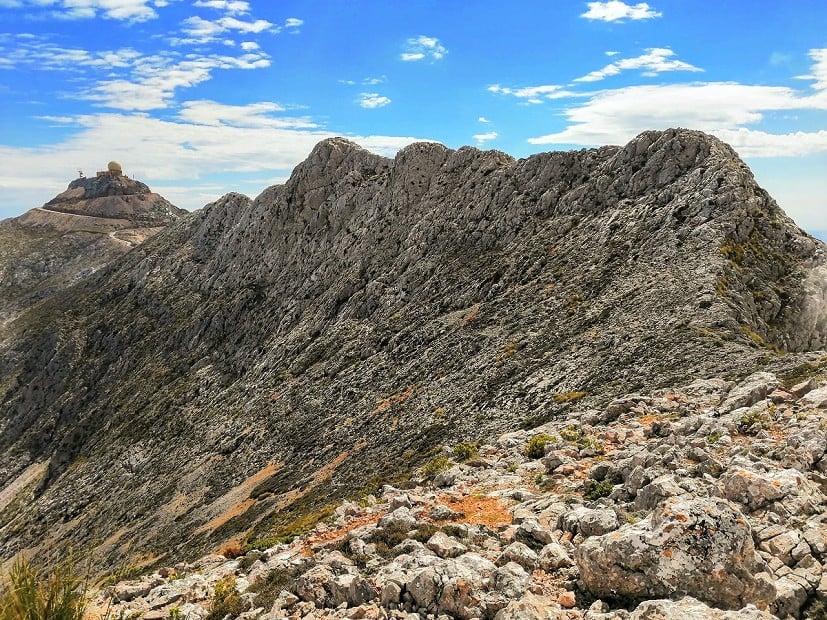 Penyal des Migdia’s exposed ridge includes the highest accessible point on the island
© Paul Harrison
Despite the altitude, most of the 54 "miles"("miles=1000-ers(peaks)are hikers' peaks. They are sheer and dramatic throughout and collapse spectacularly into the sea along the north coast but they are, almost all, accessible to day walkers of ranging ability, age and fitness. I recall my first 'mil', a tame ascent of which I was inordinately proud at the time, of Puig de Galatzo's 1027m. Upon reaching the summit, congratulating each other and taking many selfies in appropriate Goretex-clad alpine poses, we were joined by a French couple wearing sandals and carrying a picnic basket, with their six-year-old son sauntering behind.
Similarly, Puig de Massanella (1365m) is considered Mallorca's second highest peak and the highest accessible independent peak due to the restrictions on Puig Major. Yet, most Sunday afternoons, in the fair weather months, enough people visit the peak to fill a couple of coaches. Getting any solo time on that peak requires a mid-week visit in winter. Why so busy if it's so high? The classic start point is from Coll de sa Batalla where the mountain road that cyclists so adore reaches 600m above sea level and pauses at a petrol station and car park. Half the altitude has already been covered on the drive up and the hike from there, up the southern slopes to the top, whilst by no means easy, takes 3 to 4 hours of continuous but steady uphill walking. Any reasonably fit regular walker can complete it. There's no technicality and the entire route is either signposted or following clear cairns and paint marks.
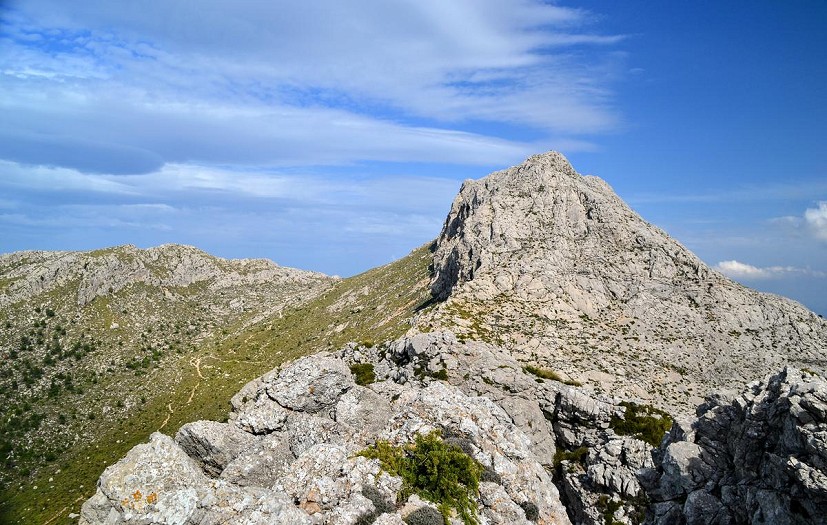 Puig de Massanella from the southwest, showing the exciting 100m scramble to the top. To the left the GR221 can be seen
© Paul Harrison
Of course, there's access too from the northern face – one of the most fun routes on the island - which requires over 100m of very steep scrambling on well-worn rock faces. This is my number one recommendation for GR221 hikers: stop at Coll des Prat, around 1200m above sea level. Drop your heavy pack, grab your water bottle and follow the two wooden arrows which direct you onto a small but distinct switch back towards the sheer cliff face looming over you. The hands-and-feet scrambling section is demanding after slogging your way up the valley all morning from the previous night's refuge or campsite but it adds at most 90 minutes to your day and delivers some of the most stunning views.
The very accessibility of the Tramuntana mountains, along with the frequent good weather, can easily lead the inexperienced to over-stretch themselves. You still need to remember your mountaincraft up here. GREIM, the national body for mountain rescue in Spain, recently published their 2018 statistics. They launched around 1100 rescue missions during the calendar year, of which 10% were to recover bodies. They claim that half of all the rescues they carried out were to bring down hikers who were ill-prepared, poorly informed, improperly equipped, unable to navigate (lost) and/or inexperienced. The Balearic Islands to which Mallorca belongs has been the area of Spain with the highest number of mountain rescue call outs every year for the last ten years – 220 last year; four each week. With 123 rescues, that's more than one in every ten across the country, almost all in Mallorca, more even than any single Pyrenean area. One famous incident in February of 2017 saw a helicopter called out to 'rescue' a couple who had decided to celebrate Saint Valentine's Day with a romantic picnic at the top of Puig de Massanella, only to find they were too tired to walk back down and wanted a lift back to their car. No doubt that resulted in the most expensive taxi they've ever called.
It's that summit view, though. Not simply in its rugged, dramatic, vertiginous splendour and scale. Not simply in its position next to the sparkling azure Mediterranean over 1000m below. Not simply in its near perpetual clear, blue, sunny skies. No, the enjoyment of the view is also the sense of having earned it. The rarity, on a busy, tourist-ridden island, of finding a vista so few others have enjoyed. The solitude of sitting on top of one of those imposing 54, knowing I've long-since conquered the easiest and on each new attempt overcome a greater challenge and a harder peak, earning the increasingly unseen panoramas that await me. Mallorca has so much to offer to so many and the Sierra de Tramuntana is its imposing mountain playground with hidden bite. For me, and all those who know, the '54 miles' are the keys to the island's most exclusive club.

 www.ukhillwalking.com
The stunning views from the dramatic peaks are the reward for all that uphill struggle and here the weather is good enough that those views are often accompanied by sunshine and picture-postcard blue skies. Even on cloudy days the altitude means I have had days of sitting on peaks above the cloud layer with clear skies overhead. However, be careful never to underestimate the speed the weather can change at elevation on an island in the middle of the sea, even a sea as benign-looking as the Mediterranean.
The trig point on top of Puig Roig, where the mountains meet the Mediterranean.© Paul Harrison
Visible across the island, the dominant peak of Puig Major (1445m) has its own strange quirk, in that it now actually measures 1436m. In order to create a flat plateau on which to build, American military engineers removed the top nine metres of the peak..
Unfortunately, the area at the top of Puig Major, and the impressive feat of engineering that is the road leading to it, is a restricted military zone and therefore inaccessible to hikers without special permission. Once I've done the other 53, I think I'll ask if they'll let me up that last one! The service road, though off limits, has been used by many a walker, this one included, as an escape route when the weather turns. One very, very windy day (70kmph+) we were literally lying flat on the ground and holding on to bare rock to avoid being blown off the mountain, when we decided we had to abandon an attempt to summit Penyal des Migdia's double peak (1382m & 1398m), on the south west ridge of the Puig Major massif, and bail out down the military road. We were very glad to have thick cloud cover filling the valley into which we descended as the visibility of less than 10m made exiting through the dry streambed around the guard house and past the barracks rather harder to detect and easier to excuse if challenged!
Penyal des Migdia’s exposed ridge includes the highest accessible point on the island© Paul Harrison
Despite the altitude, most of the 54 "miles"("miles=1000-ers(peaks)are hikers' peaks. They are sheer and dramatic throughout and collapse spectacularly into the sea along the north coast but they are, almost all, accessible to day walkers of ranging ability, age and fitness. I recall my first 'mil', a tame ascent of which I was inordinately proud at the time, of Puig de Galatzo's 1027m. Upon reaching the summit, congratulating each other and taking many selfies in appropriate Goretex-clad alpine poses, we were joined by a French couple wearing sandals and carrying a picnic basket, with their six-year-old son sauntering behind.
Similarly, Puig de Massanella (1365m) is considered Mallorca's second highest peak and the highest accessible independent peak due to the restrictions on Puig Major. Yet, most Sunday afternoons, in the fair weather months, enough people visit the peak to fill a couple of coaches. Getting any solo time on that peak requires a mid-week visit in winter. Why so busy if it's so high? The classic start point is from Coll de sa Batalla where the mountain road that cyclists so adore reaches 600m above sea level and pauses at a petrol station and car park. Half the altitude has already been covered on the drive up and the hike from there, up the southern slopes to the top, whilst by no means easy, takes 3 to 4 hours of continuous but steady uphill walking. Any reasonably fit regular walker can complete it. There's no technicality and the entire route is either signposted or following clear cairns and paint marks.
Puig de Massanella from the southwest, showing the exciting 100m scramble to the top. To the left the GR221 can be seen© Paul Harrison
Of course, there's access too from the northern face – one of the most fun routes on the island - which requires over 100m of very steep scrambling on well-worn rock faces. This is my number one recommendation for GR221 hikers: stop at Coll des Prat, around 1200m above sea level. Drop your heavy pack, grab your water bottle and follow the two wooden arrows which direct you onto a small but distinct switch back towards the sheer cliff face looming over you. The hands-and-feet scrambling section is demanding after slogging your way up the valley all morning from the previous night's refuge or campsite but it adds at most 90 minutes to your day and delivers some of the most stunning views.
The very accessibility of the Tramuntana mountains, along with the frequent good weather, can easily lead the inexperienced to over-stretch themselves. You still need to remember your mountaincraft up here. GREIM, the national body for mountain rescue in Spain, recently published their 2018 statistics. They launched around 1100 rescue missions during the calendar year, of which 10% were to recover bodies. They claim that half of all the rescues they carried out were to bring down hikers who were ill-prepared, poorly informed, improperly equipped, unable to navigate (lost) and/or inexperienced. The Balearic Islands to which Mallorca belongs has been the area of Spain with the highest number of mountain rescue call outs every year for the last ten years – 220 last year; four each week. With 123 rescues, that's more than one in every ten across the country, almost all in Mallorca, more even than any single Pyrenean area. One famous incident in February of 2017 saw a helicopter called out to 'rescue' a couple who had decided to celebrate Saint Valentine's Day with a romantic picnic at the top of Puig de Massanella, only to find they were too tired to walk back down and wanted a lift back to their car. No doubt that resulted in the most expensive taxi they've ever called.
It's that summit view, though. Not simply in its rugged, dramatic, vertiginous splendour and scale. Not simply in its position next to the sparkling azure Mediterranean over 1000m below. Not simply in its near perpetual clear, blue, sunny skies. No, the enjoyment of the view is also the sense of having earned it. The rarity, on a busy, tourist-ridden island, of finding a vista so few others have enjoyed. The solitude of sitting on top of one of those imposing 54, knowing I've long-since conquered the easiest and on each new attempt overcome a greater challenge and a harder peak, earning the increasingly unseen panoramas that await me. Mallorca has so much to offer to so many and the Sierra de Tramuntana is its imposing mountain playground with hidden bite. For me, and all those who know, the '54 miles' are the keys to the island's most exclusive club.
Climbing Mallorca's 1000m Peaks
Climbers and cyclists flock to Mallorca, but this rugged island also deserves to be better known for hillwalking, says local resident Paul Harrison. Here's his guide to Mallorca's 1000m...
www.ukhillwalking.com
Last edited: