What's new
Anthro World Forum

This is an anthropology forum where we cover all sorts of topics and discussions. Once signed in, you'll be able to participate on this site by adding your own topics and posts. Register today to become a member!

The hidden history of humanity.Impostors/Jews(Rev. 2:9)deceived the world and DNA confirmed it

BarcelonaAtlantis

Moderator
Staff member
There have been records of giants in Palma since 1734 but giants modelled on everyday people did not make their appearance until 1904 when the Town Council commissioned the ceramicist La Roqueta de Palma to make a pair of giants. This introduced a style that has been immensely popular ever since. They were known as Tofol and Bet-Maria and took part in festivals until 1936, when they were lost in the upheaval of the commencement of the Civil War during a visit to Barcelona.
During the forties, there was another pair, Tofol and Francinaina. They stood immobile outside the Town Hall during important city event. Unfortunately, they too came to a sorry end when, overturned by a gust of wind, they were vandalised.

In the sixties, the Town Council commissioned another pair by the sculptors Joan Montserrat Palmer and Francesc Vives Bellaflor, made from cardboard and wood with a close resemblance to those at the beginning of the century. They were named Tofol and Francinaina. At the present time they stand at the entrance to the Palma Town.

Two others, two musicians or xeremiers, joined them in the eighties, followed by Tomeu and Margalida, made by Arts Plàstiques Guaita in Valencia, in 1999. Both weigh fifty kilos and are 4 metres tall. Visiting Catalonia, Spain and France, they are the most widely travelled of the Island giant


BarcelonaAtlantis

Moderator
Staff member

MAJORCAN GIANTS-MAJORCAN FOLKLORE-GIANTS ENCOUNTER​

Image
MAJORCAN GIANTS-MAJORCAN FOLKLORE-GIANTS ENCOUNTER-MAJORCAN ROOTED TRADITIONS
To find the origins of the early giants in Mallorca we would have to go back to the seventeenth century and to the village of Soller where we found the first giant in the procession of Corpus Christi.
To raise awareness of the biblical passages, the roman catholic church organized the «entremeses» (short theatrical performances) where are already involved the giants.
It seems that the first documented reference to the existence of giants appears in Cataluña,the year 1424 (solemnitats book of the city) and refers to King David and the Giant.
Chronologically the next giant in Mallorca that we know is in Sineu. It Appears disconnected from the feast of Corpus Christi and is part of the celebrations of Sint Roc in 1653 and was made by the local artist Pere Antoni Real.
In the city of Palma, the giants were appearing in the procession of Corpus Christi in 1734,after requesting permission from the Dean of the Cathedral to participate on it, finally ,the permit arrived on June 21st and the Palma´s Giants may participate in the procession of Corpus Christi in Palma, and were allowed to enter into the cathedral «La Seo» and they were installed in the chapel of Our Lady of the Navigators, nowadays dedicated to St. Benedict.
In 1762 in Sant Llorenç (Mallorca) we find “Puput» ,the first Mallorcan giant that we know the name.
And so gradually the giants figures were proliferating across the whole island, Pollença, Manacor, Llucmajor …..
But the giants had to face the prohibitions imposed by the Council of Trento(1545-1563), the decret of nueva planta by King Philip V (1716) and the Royal law issued by Charles III in1780 among many other local restrictions .
All these laws were clearly designed to limit and prohibit the participation of the giants in any folk event, “entremeses” or ecclesiastical procession. Because,specially the roman Catholic Church in Spain considered that this representations had become farcical,burlesque and had lost its biblical sense.
Unfortunately because of this break between the Catholic Church and the tradition of the giants, many of these figures will disappear and will be the craft guilds, the ones who adopted the giants, eagles, dragons, horses … as their emblems.
But the decree of Nueva Planta will impose that “entremeses” and other properties of the craft guilds will become municipal property, so the giants will be in hands of the different municipalities on the island.
The law promulgated by king Carlos III will be another blow to the tradition of the giants, because it specifically prohibits the participation of the giants in any popular procession or demonstration, in this situation many figures will disappear or have to hide ,to avoid being destroyed and there were people, who even turned a deaf ear to the prohibition and remained using giants.
In Mallorca it seems that giants have been protected by the Augustinians in the convent of Bon Socors.
The giants will reappear in Palma in 1814 during the festival of San Fernando (in honor of Ferdinand VII) and during the nineteenth century will be part of the stories written by the Archiduke Ludwing Salvador of Austria in his book Die Balearen and also in this century will be the birth of other emblematic giants, the giants of Llucmajor, which were participating in the festivities of Santa Candida (1893)

In 1902 taked place in Barcelona the first giants encounter ,who joined 150,000 people around the giants.

In 1904 the city of Palma Mallorca ordered to the ceramic Factory ”La Roqueta” two giants similar to those that today are exhibited in Cort.

There were two proposals, the first, made by the sculptor Miquel Vadells which was disregarded and the one which was accepted, was the one of “la Roqueta”.

The works were directed and coordinated by the owner of the factory, Pere Cetre, and there comes a giant and a giantess dressed as the peasants (payeses).

They were baptized with the names of Tofol and Beth-Maria and had certain peculiarities for that time, his eyes were moving and the giant smoked a pipe with smoke coming out continually.

The jewelry carrying by the giantess had been developed by the goldsmith from Palma, Paul Taronjí and were composed of set of buttons, lacing, a Cross of Malta.rings….

But Tofol and Bet Maria(called by everybody Francina or Francinaina) had a tragic fate in 1936 they left Mallorca towards Barcelona to participate in the opening ceremony of the popular Olympics, at the very momento when then Civil war breaks out and there we were losing their track forever, and never returned to Mallorca

So in 1940 the municipality of Palma,requested Sebastian Alcover to build other two giants similar to the missing, Tofol and Francinaina, but their destiny was not better than their predecessors and were destroyed years later, by a wind gust when they were exposed in the entrance of Cort and finally the vandalism of a group of young ended up leaving them unserviceable.

Mallorcan giants can be classified into five major groups:

Couples of peasants, is the most numerous, and the oldest members are the ones from Inca (Abdó i Maria), 1928, to this group belongs Francinaina and Tofol from Palma (1961), 1983 the peasant (payes) from Son Rapinya, in 1987 the ones from Sa Pobla (Antoni and Margalida), in 1989 the ones from Alcudia (Rampell and Pipella), Llucmajor (Miquel i Càndida), Sant Llorenç (Jaume Belluguins and Angelina Trevolina) 1996 the ones from Sóller (Antoni and Catherine ). In 1999 Palma ordered a couple procesional peasants (Tomeu and Margalida) to accompany the giants xeremiers, in Selva 2002 (Pau and Rosa), in 2005 in Son Espanyolet (Gaietà and Catalina) and to all of these are joined two couples one from Felanitx and one from San Jordi and we don´t know either the name or the date when they were made.

-In the second group we would include the giants inspired in characters coming from our rondalles or legends such as those of Llucmajor, ordered in 1970 to Valencia, Pere Taleca and Fada Morgana and in 1971 the Amo de So Na Moixa i Na Joanota.

In Montuïri, Queen Catalineta, private property of Vicente Alberdola(1994) and Na Tomassa from Alaro 1995, in Colonia de Sant Jordi, a Queen and Marti Tacó 1997-98.

In 2000 the Magisterium Theatre Group in the University (UIB) built several giant for the representation for the theatre play”l´amor de les tres taronges”. In 2002 from Puigpunyent the Bou and Na Fatima, and finally from Palma, Banyeta Verda and Banyeta Vermella (2004).

And the third will be time lucky in 1961, the City Council paid 35,000 pesetas to Monserrat Palmer and Joan Francesc Vives Bellaflor for the actual Tofol and Francinaina, exposed in the lobby of Cort, they are 4.20 mtrs tall and are made of wood, cardboard and wicker but they are too heavy to be carry so in 2005 the municipality invested 15000 euros and the workshop “Xicaranda” wil restored them and makes the garments which they wear nowadays.

-The third group consists of traditional crafts representing each locality on the island, as the shoemakers from Inca (1994), in Capdepera ,Roc (fisherman) and n’Esperança (llatadora palm-craft) 2003 in 2005 from Sineu (Maria Angels figs harvester and Marc, the blacksmith) and from Manacor de la Vall (Joan, coalmen and Llucia, embroider maker)
 
Last edited:

BarcelonaAtlantis

Moderator
Staff member
-In the last group all others, as the oldest processional couple from Mallorca: the ones from Manacor ,Vincenç (a Moor, 1942) and na Catalina (peasantgirl, 1933). The witch Taven from Llucmajor (1970), xeremiers from Palma (1973), the pair of Petra, 1980 or the figure of a young from Son Cladera (1983). From 2002 is the demon giant belonging to Factoria de So from Santa Maria and Sa Siurella from Marratxí. In 2004 xeremiers from Muro (Toni and Joan) and Na Comas and En Comaro from Son Sardina, or Cosmet 2005, as Toni (artisan) i na Maria Angels (culture) of Pollença.

A total of 74 giant figures that we have today in Mallorca, with its grandiosity (never better said) and spectacular beauty.

Today giants are an important part of our folklore and our culture and this is why giants encounters or trobades are organized in Mallorca,as the one held last Saturday April 27th in Sineu or this Saturday May 4th in Santa Maria.

At the giants encounter last Saturday in Sineu, the hosts Maria Angeles and Marc welcomed their guests and staged a colorful parade through the streets of the town.

If you could not attend to the giangts encounter in Sineu from Mallorca Private Tour Guides, we encourage you to not miss the giants encounter next Saturday in Santa Maria.

Knowing our folklore and traditions is part of our culture, and if the Giants during their history have gone through so many obstacles and still been able to reach these days, we believe that they deserve our support and respect.

Join Mallorca Private Tour Guides and do not miss the giants encounter in Santa María next Saturday.

Let us guide you through our culture and folklore and discover with the guides of Mallorca Private Tour Guides, the Mallorcan folklore, let yourself be enthralled by the beauty of our people, by the joyful sound of the music of the xirimies (Mallorcan bagpipe) and the greatness of our giants,their elaborate garments and crafts and traditions that they represent.

With Mallorca Private Tour Guides discover Mallorcan giants and its origins, sure you’ve seen them many times participating in our celebrations and parades through our streets, but we are sure you were not unaware of its history, come and discover them with us.

Mallorca private tour guides team

PD. Soon we will present them through a photo blog so that you can discover something from each of them. Do not miss it …..


Funnily enough in catalan elves is spelled dimonis meaning demons.So much confussion now agh.
 
Last edited:

BarcelonaAtlantis

Moderator
Staff member
Thoroughly modern cosmopolitan capital of Mallorca it may be, but Palma still maintains many of its charming old traditions. One of its loftiest is the annual meeting of the giant who stand about, parade and dance supported by a cast of big-heads, demons, folk dancers and musicians.

Obviously they're not real giants, but enormous 'puppets' made of light wood and material with room inside for a 'driver' who does all the jigging about unseen. It's a tradition which can be traced back as far as 1630 to Soller(Soller,of course......it had to be Soller....) with various ups and downs through the years though they are now seen as an essential part of folk custom and heritage. The giants are an incredible 4 metres tall and normally dressed as Mallorcan country folk with agricultural tools, baskets, fans and musical instruments.

The giant meeting takes place this Saturday, 9th September in the Plaza de Cort (the town hall square) at 10:30 when 25 different groups will participate and will include around 50 giants, 20 big heads with a total of 400 people taking part. The big parade through the streets starts from the Cort at 11:30 and will make its way along Calle Colon, la plaza Mayor, Sant Miguel and end up in la plaza de Espanya.

It's a popular event, great fun, and worth interrupting your shopping to go and have a look. Why not pop along if you're in Palma on Saturday?https://www.mallorca-spotlight.com/news/2017/09/gigantic-parade-palma


Claper des Gegants
Capdepera

A place of legend!
Claper des Gegants is really a talayot, one of those prehistoric structures made of such huge stones that they could only have been made by giants. Claper des Gegants is also called Talayot de s’Heretat and it is one of the most important still to be found on Majorca https://www.wowmallorca.com/en/etnos/3198

 
Last edited:

BarcelonaAtlantis

Moderator
Staff member

Because its fake science/impostors.Spaniards/crypto pharisees/crypto jews vs Basques/Catalans/Holy Grail/Celts

 
Last edited:

BarcelonaAtlantis

Moderator
Staff member


Serra de Tramuntana Info​

Serra de Tramuntana

Serra de Tramuntana is the name of a mountain range in northwest Mallorca. It covers 1100 sq km, with the highest peaks concentrated in its centre. It was awarded World Heritage Status by UNESCO in 2011 for its physical and cultural significance, shaped by millennia of agriculture in an inhospitable terrain.

Thousands of hikers visit Mallorca to hike the Serra de Tramuntana every year, and it’s easy to see why. The views are just spectacular! You can easily come here for a short day-trip or walk the whole damn thing.

GR221 Dry Stone Path

Whichever option you choose, you’ll most likely be taking the GR221 dry stone path. This long-distance route takes you from hilltop villages to historic monasteries, across mountain peaks and past glimmering water reservoirs.

The trail is based on a network of ancient footpaths which are gradually being restored by the local government. When it’s finished it will consist of 271 km, distributed amongst eight stages of the main route and nine variants.

At the moment it comprises of 167 km which are open to the public and signposted, 85 km of which correspond to the main itinerary and 82 km to the variants. Four full stages are open, linking Deià to Pollença, as well as the section between Banyalbufar and Esporles.

So don’t worry, even the most ardent hikers will find something to do! You can find the full official guide to the GR221 here for free.https://girlvsglobe.com/serra-de-tramuntana-hiking-guide/
 
Last edited:

BarcelonaAtlantis

Moderator
Staff member

Now indoctrinated morons think these people are the bad people because the impostors/bad people pretend to be these people​

 
Last edited:

BarcelonaAtlantis

Moderator
Staff member


Geology.

Much of Mallorca is made up of limestone. This type of rock dissolves over time in water and gives rise to gorges and the many cave systems found in the foothills of the mountainous regions.The fact that limestone creates natural holds is the main reason why the island is very popular among climbers, especially for water soloing on cliffs.


The Tethys Ocean,(also called the Tethys Sea or the Neo-Tethys), was an ocean during much of the Mesozoic Era and early Cenozoic Era, located between the ancient continents of Gondwana and Laurasia, before the opening of the Indian and Atlantic oceans during the Cretaceous Period.
It was preceded by the Paleotethys Ocean, which lasted between the Cambrian and the Early Triassic, while the Neotethys formed during the Late Triassic and lasted until the early Eocene (about 50 million years ago) when it completely closed.A portion known as the Paratethys formed during the Late Jurassic, was isolated during the Oligocene (34 million years ago) and lasted up to the Pliocene (about 5 million years ago), when it largely dried out. Many major seas and lakes of Europe and Western Asia, including the Mediterranean Sea, the Black Sea, the Caspian Sea, the Aral Sea, and Lake Urmia, are thought to be remnants of the Paratethys.https://en.wikipedia.org/wiki/Tethys_Ocean

The (first) Tethys Sea starts dividing Pangaea into two supercontinents, Laurasia and Gondwana.oldmaps[1].png
 
Last edited:

BarcelonaAtlantis

Moderator
Staff member

Mallorca Monday: How the Balearic Islands Were Formed​

Posted on March 18, 2019by stuffedeyes
Hawaii is made from underwater volcanoes Come with us 250 million years ago to the Triassic Period (just before your favorite period – the Jurassic one, you know, the one with all the dinosaurs).
Mammals looked like this:
Pristeroognathus_DB.jpg

And the world looked like this:
oldmaps.png


You may be familiar with Pangea (when everything was one hunkin’ continent). This is the adolescent period after Pangea when all the continents were moving around. Like a complicated relationship, they split up for a while, surely screaming “That’s for cheating on me with India” as they drifted away, the sea filling up the space between them. But after a while they had some time to think. They hit the gym, deleted Facebook and saw a very nice therapist. They changed as landmasses and some of them reconnected.
Here’s an animation that summarizes 158 million years of this (and if you can’t see the animation go here). India comes running desperately back, Australia is done with that toxicity, and Africa and North America both split in twain for a moment.
QuestionableAnyClingfish-size_restricted.gif

And then…​

Africa and Eurasia came smashing back together. They were like the lovers running back into each other’s arms. “Africa, it’s been too long!” Eurasia surely screamed as they embraced. They ran into each other so hard that the Alps were pushed upwards into existence and the Mediterranean sea (not called that) was made deeper.
They held each other for a long time. So long, in fact, that the Mediterranean stopped existing. The Atlantic ocean was completely cut off from the Mediterranean and it dried up. Maybe even completely, maybe there were hypersalty lakes that dotted where the sea had been.
Erosion and wind exposure created huge canyons and valleys. Think New Mexico or the Grand Canyon. Only much saltier.
dsc06648.jpg

If you were standing at the bottom of what-is-now-the-Mediterranean, with it all dried out and windy, you could die from the pressure (of the air pressure, not water pressure) and it would be 170F (80C). Deadly.
Around half a million years after Africa and Eurasia’s big embrace (they’ve been holding each other awkwardly possibly for .6 million years) Africa awkwardly took a step back. This caused the Gibraltar Strait to break open. Flooding all the water back in.
This is the Zanclean flood. Imagine a 1 mile high waterfall (or more) sending all the water from the Atlantic ocean through a tiny (8 mile) hole. Picture this absolute deluge of water. The Mediterranean filled up between some months and two years. The water inside went up 30 feet (10 meters) per day as the whole basin filled in. Global sea levels decreased by about 30 feet. Probably nothing inside survived. Any special creatures or plants that had figured out how to live in the insane pressure/heat/salt canyon-desert were wiped out. Animals from the Atlantic were washed into the Mediterranean via waterfalls and flooding. They obviously couldn’t go back up to the Atlantic. So they figured out what to do in their new home.

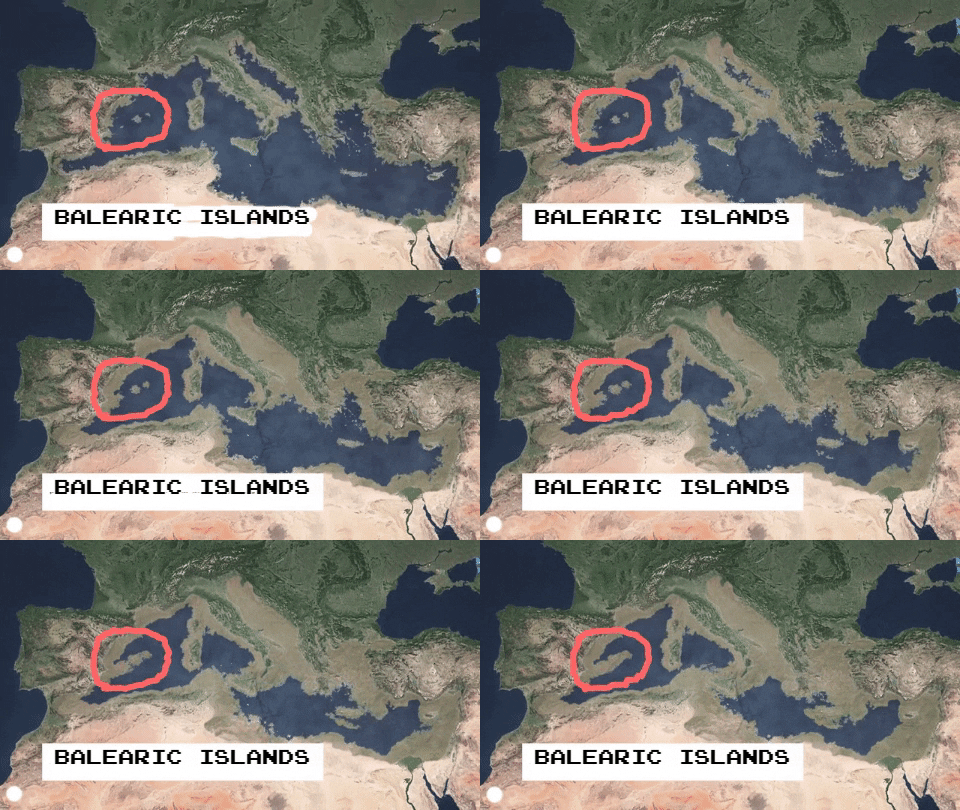
So where are the Balearic Islands in all of this?​

Where are the Balearic Islands in all of this?​

During all the changing of the 2 supercontinents, the dolomite and limestone that make up the island were forming. This takes forever so you can’t just say “it happened.”

historygoeg.png

The Balearic Islands were there, they were just working on their limestone while being twisted, pulled apart and shifted around as everything else got shifted around.
Just as Africa was looking like Africa and was preparing to get close to Europe, (Eocene epoch), shallow water was forming reefs around the island.
Just as the Caspian/Black seas were closing up from the sea (Oligocene epoch), the Balearic Islands were forming their mountains with contractions and sedimentation.
Just before the Nordic countries started looking Nordic (Miocene epoch), the contractions near the island stopped and dolomite and limestone was more or less as it is now.
When all the shifting was basically finished, the Balearic Islands and the basin of water around them shifted in a clockwise direction.
When the water began to evaporate they stopped being islands. They were always connected to Spain(Iberia rather...) underwater, but now there was no water. You could’ve walked from Barcelona and Valencia to the Islands. They also weren’t separated, you could walk from Mallorca to Menorca. If you can’t see the animation click here.
giphy.gif

Then just picture this in reverse as the water came back in.

Modern Day​

Now there is just a small hole- only 8.9 miles (14.3 km) separating Europe from Africa. Africa is possibly moving towards Europe again so someday in the future this very thing could happen again. Maybe in millions of years you won’t have to take a boat or plane to get to the islands. We may have a train or road that goes from Barcelona to the Balearics over a mountain range.
Because there’s little space between the Atlantic and Mediterranean it is currently evaporating. It’s always evaporating. The tide doesn’t exactly come in or circulate through the 8 mile hole. So the Med needs rainfall to keep it “normal.” Without enough rain, the water evaporates and it keeps getting saltier and saltier. This makes small changes in landscapes and coastlines over time (but not so fast that we can see).

And the Balearic Islands?​

Mallorca is unusually fertile and green compared to other Mediterranean islands. It also had unique animals native only to the islands for a while (they’re dead now).
The limestone that makes up the islands dissolves naturally over time. This has created massive caves around the island. The most famous of which is Cuevas del Drach in Porto Cristo (near Manacor). The limestone has also helped humans to get water – all of our water seeps through the limestone to make underground water reserves. This is good for wells but bad for sustaining large populations.
Everyone’s favorites are probably the calas – the coves that create perfect little beaches. This is thanks to all the shifting, pushing, breaking and spinning from the Neogene and Paleocene periods.
It got the winning combo of fertile lands and mountains after all the shifting was finished. This combo has helped animals and people farm and live for a long time. It helped them drink and survive. The extreme coastline of mountains leading into the sea have helped create natural defenses (but only in some places). Now it’s given people touristy caves, rock climbing and hiking and beautiful beaches. All in all, a good place to live, and now, a good place to visit. All thanks to 245 million years of hard work. https://stuffedeyes.com/2019/03/18/mallorca-monday-how-the-balearic-islands-were-formed/
 
Last edited:
Top