

DBorgia
Member
The Kingdom of Valencia (Reino de Valencia; Latin: Regnum Valentiae), located in the eastern shore of the Iberian Peninsula, was one of the component realms of the Crown of Aragon. When the Crown of Aragon merged by dynastic union with the Crown of Castile to form the Kingdom of Spain, the Kingdom of Valencia became a component realm of the Spanish monarchy.
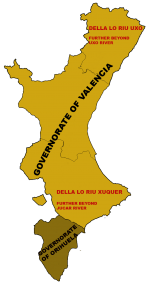
The Kingdom of Valencia was formally created in 1238 when the Moorish taifa of Valencia was taken in the course of the Reconquista. It was dissolved, along the other components of the old crown of Aragon, by Philip V of Spain in 1707, by means of the Nueva Planta decrees, as a result of the Spanish War of Succession.
During its existence, the Kingdom of Valencia was ruled by the laws and institutions stated in the Furs (charters) of Valencia which granted it wide self-government under the Crown of Aragon and, later on, under the Spanish Kingdom.
The boundaries and identity of the present Spanish autonomous community of the Valencian Community are essentially those of the former Kingdom of Valencia.
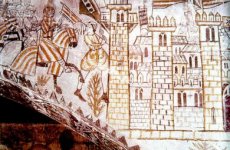
The King James I entered the city of Valencia on 9 October 1238

The Contract Hall in La Llotja de la Seda
The Kingdom of Valencia achieved its height during the early 15th century. The economy was prosperous and centered around trading through the Mediterranean, which had become increasingly controlled by the Crown of Aragon, mostly from the ports of Valencia and Barcelona.
The Kingdom of Valencia was formally created in 1238 when the Moorish taifa of Valencia was taken in the course of the Reconquista. It was dissolved, along the other components of the old crown of Aragon, by Philip V of Spain in 1707, by means of the Nueva Planta decrees, as a result of the Spanish War of Succession.
During its existence, the Kingdom of Valencia was ruled by the laws and institutions stated in the Furs (charters) of Valencia which granted it wide self-government under the Crown of Aragon and, later on, under the Spanish Kingdom.
The boundaries and identity of the present Spanish autonomous community of the Valencian Community are essentially those of the former Kingdom of Valencia.
The King James I entered the city of Valencia on 9 October 1238
The Contract Hall in La Llotja de la Seda
The Kingdom of Valencia achieved its height during the early 15th century. The economy was prosperous and centered around trading through the Mediterranean, which had become increasingly controlled by the Crown of Aragon, mostly from the ports of Valencia and Barcelona.


