idklolimo
Well-known member
The Gypsies, who are believed to have left their home in the lower Indus Valley about the turn of the present millennium, and who arrived in Europe some four centuries later, belong, when comparatively unmixed, to a dark-skinned, small-bodied racial type of general Mediterranean appearance which is common in India.
FIG. 1 (2 views, photo V. Lebzelter, from "Anthropologische Untersuchungen an serbischen Ziguenern," MAGW, vol. 52, 1922). A nomadic Serbian Gypsy, apparently relatively pure, who shows the characteristic Gypsy combination of straight jet black hair, black eyes, and dark skin, in connection with Mediterranean facial features.

FIG. 2 (2 views). An English Gypsy of the Cooper family, whose ancestors moved to New England a century ago. Although some of the Coopers and Stanleys are blue-eyed and show other signs of non-Gypsy mixture, this individual possesses a sallow brownish skin, straight, coarse, shiny black hair, and dark brown eyes. He is apparently a relatively pure representative of the Gypsy prototype

FIG. 3 (2 views). Of much greater antiquity outside of India is a dark-skinned, black-eyed, and straight-haired Mediterranean type which appears with some frequency in southern Iraq and along the coasts of the Persian Gulf. This young sailor from Kuwait will serve as an example. The origin and affiliations of this type have not as yet been fully explained.

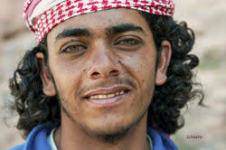
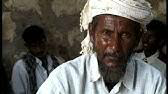
FIG. 4 (2 views). In southern Arabia, south of the Ruba' el Khali desert, the populations consist of a Mediterranean upper stratum overlaid upon a non-white racial group whose affinities are with the Vedda of Ceylon, and the curly-haired aboriginal tribes of southern India; more remotely, it possesses strong connections with the aborigines of Australia. The individual shown in Fig. 4 is an extreme example of this Veddoid prototype. Note the great prognathism, the ringlet hair form, the extreme nasion depression, and the general form of the nose and lips. Except for his light unexposed skin color, this individual, who is quite brown where exposed, could pass for an Australian aborigine.

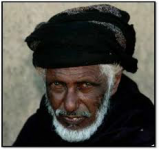
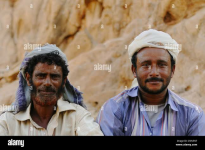
FIG. 5 (2 views). A coarse type of Hadhramauti, who represents a mixture between the Veddoid element shown above and the Mediterranean race; or who might be called a less extreme example of the former.

FIG. 6 (2 views, photo Wm. M. Shanklin). A coarse, dark-skinned type of Ruwalla Bedawi. Among the North Arabian Bedawin, besides the more delicately formed Mediterranean types already observed, occur individuals who seem to show relationships with the Veddoid element on the other side of the desert, and perhaps also with the deeply pigmented element of southern Iraq, as exemplified by Fig. 3. Tribes and populations possessing these racial elements do not possess the normal 25 per cent of incipient blondism characteristic of most Mediterranean groups.

FIG. 1 (2 views, photo V. Lebzelter, from "Anthropologische Untersuchungen an serbischen Ziguenern," MAGW, vol. 52, 1922). A nomadic Serbian Gypsy, apparently relatively pure, who shows the characteristic Gypsy combination of straight jet black hair, black eyes, and dark skin, in connection with Mediterranean facial features.
FIG. 2 (2 views). An English Gypsy of the Cooper family, whose ancestors moved to New England a century ago. Although some of the Coopers and Stanleys are blue-eyed and show other signs of non-Gypsy mixture, this individual possesses a sallow brownish skin, straight, coarse, shiny black hair, and dark brown eyes. He is apparently a relatively pure representative of the Gypsy prototype
FIG. 3 (2 views). Of much greater antiquity outside of India is a dark-skinned, black-eyed, and straight-haired Mediterranean type which appears with some frequency in southern Iraq and along the coasts of the Persian Gulf. This young sailor from Kuwait will serve as an example. The origin and affiliations of this type have not as yet been fully explained.
FIG. 4 (2 views). In southern Arabia, south of the Ruba' el Khali desert, the populations consist of a Mediterranean upper stratum overlaid upon a non-white racial group whose affinities are with the Vedda of Ceylon, and the curly-haired aboriginal tribes of southern India; more remotely, it possesses strong connections with the aborigines of Australia. The individual shown in Fig. 4 is an extreme example of this Veddoid prototype. Note the great prognathism, the ringlet hair form, the extreme nasion depression, and the general form of the nose and lips. Except for his light unexposed skin color, this individual, who is quite brown where exposed, could pass for an Australian aborigine.
FIG. 5 (2 views). A coarse type of Hadhramauti, who represents a mixture between the Veddoid element shown above and the Mediterranean race; or who might be called a less extreme example of the former.
FIG. 6 (2 views, photo Wm. M. Shanklin). A coarse, dark-skinned type of Ruwalla Bedawi. Among the North Arabian Bedawin, besides the more delicately formed Mediterranean types already observed, occur individuals who seem to show relationships with the Veddoid element on the other side of the desert, and perhaps also with the deeply pigmented element of southern Iraq, as exemplified by Fig. 3. Tribes and populations possessing these racial elements do not possess the normal 25 per cent of incipient blondism characteristic of most Mediterranean groups.